

Health Library
Dementia - keeping safe in the home
Dementia - home safety
Images
I Would Like to Learn About:
Description
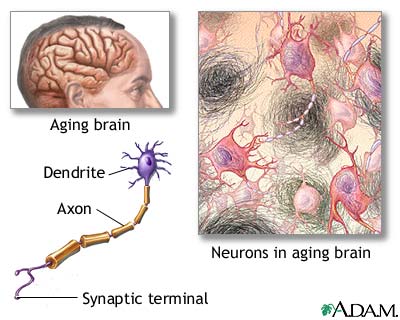
It is important to make sure the homes of people who have dementia are safe for them.
Safety Tips For The Home
Wandering can be a serious problem for people who have more advanced dementia. These tips may help prevent wandering:
- Place alarms on all doors and windows that will sound if they are opened.
- Place a Stop sign on doors to the outside.
- Keep car keys out of sight.
To prevent harm when someone with dementia does wander:
- Have the person wear an ID bracelet or necklace with their name, address, and phone number on it. Include a caretaker's contact information, if possible.
- Tell neighbors and others in the area that the person who has dementia may wander. Ask them to call you or to help them get home if this happens.
- Fence and close off any areas that may be dangerous, such as a stairwell, a deck, a hot tub, or a swimming pool.
- Consider giving the person a GPS device or a cell phone with a GPS locator embedded in it.
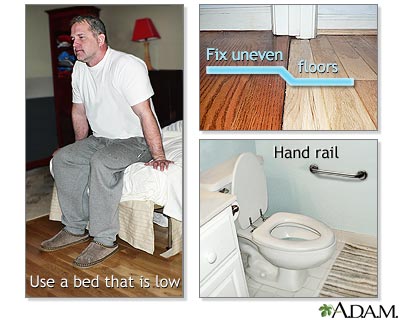
Inspect the person's house and remove or reduce hazards for tripping and falling.
Do not leave a person who has advanced dementia alone at home.
Lower the temperature of the hot water tank. Remove or lock up cleaning products and other items that may be poisonous.
Make sure the kitchen is safe by:
- Removing knobs on the stove when it is not in use.
- Locking up sharp objects.
Remove, or store the following in locked areas:
- All medicines, including the person's medicines and any over-the-counter medicines and supplements.
- All alcohol and illegal drugs.
- All weapons and guns. Separate ammunition from the guns.
Related Information
Brain aneurysm repairStroke
Dementia
Alzheimer disease
Communicating with someone with aphasia
Dementia and driving
Dementia - behavior and sleep problems
Dementia - daily care
Swallowing problems
Dry mouth during cancer treatment
Communicating with someone with dysarthria
Preventing falls
Stroke - discharge
Dementia - what to ask your doctor
References
Alzheimer's Association website. Dementia care practice recommendations. www.alz.org/professionals/professional-providers/dementia_care_practice_recommendations. Accessed April 20, 2026.
Budson AE, Solomon PR. Life adjustments for memory loss, Alzheimer's disease, and dementia. In: Budson AE, Solomon PR, eds. Memory Loss, Alzheimer's Disease, and Dementia. 3rd ed. Philadelphia, PA: Elsevier; 2022:chap 28.
Knopman DS. Cognitive impairment and dementia. In: Goldman L, Cooney KA, eds. Goldman-Cecil Medicine. 27th ed. Philadelphia, PA: Elsevier; 2024:chap 371.
National Institute on Aging website. Alzheimer's caregiving: home safety tips. www.nia.nih.gov/health/safety/alzheimers-caregiving-home-safety-tips. Updated August 2, 2024. Accessed April 211, 2026.
BACK TO TOPReview Date: 4/9/2026
Reviewed By: Frank D. Brodkey, MD, FCCM, Associate Professor, Section of Pulmonary and Critical Care Medicine, University of Wisconsin School of Medicine and Public Health, Madison, WI. Also reviewed by David C. Dugdale, MD, Medical Director, Brenda Conaway, Editorial Director, and the A.D.A.M. Editorial team.
 | A.D.A.M., Inc. is accredited by URAC, for Health Content Provider (www.urac.org). URAC's accreditation program is an independent audit to verify that A.D.A.M. follows rigorous standards of quality and accountability. A.D.A.M. is among the first to achieve this important distinction for online health information and services. Learn more about A.D.A.M.'s editorial policy, editorial process and privacy policy. A.D.A.M. is also a founding member of Hi-Ethics. This site complies with the HONcode standard for trustworthy health information: verify here. |
The information provided herein should not be used during any medical emergency or for the diagnosis or treatment of any medical condition. A licensed medical professional should be consulted for diagnosis and treatment of any and all medical conditions. Links to other sites are provided for information only -- they do not constitute endorsements of those other sites. No warranty of any kind, either expressed or implied, is made as to the accuracy, reliability, timeliness, or correctness of any translations made by a third-party service of the information provided herein into any other language.
© 1997-
2026 A.D.A.M., a business unit of Ebix, Inc. Any duplication or distribution of the information contained herein is strictly prohibited.
All content on this site including text, images, graphics, audio, video, data, metadata, and compilations is protected by copyright and other intellectual property laws. You may view the content for personal, noncommercial use. Any other use requires prior written consent from Ebix. You may not copy, reproduce, distribute, transmit, display, publish, reverse-engineer, adapt, modify, store beyond ordinary browser caching, index, mine, scrape, or create derivative works from this content. You may not use automated tools to access or extract content, including to create embeddings, vectors, datasets, or indexes for retrieval systems. Use of any content for training, fine-tuning, calibrating, testing, evaluating, or improving AI systems of any kind is prohibited without express written consent. This includes large language models, machine learning models, neural networks, generative systems, retrieval-augmented systems, and any software that ingests content to produce outputs. Any unauthorized use of the content including AI-related use is a violation of our rights and may result in legal action, damages, and statutory penalties to the fullest extent permitted by law. Ebix reserves the right to enforce its rights through legal, technological, and contractual measures.
